

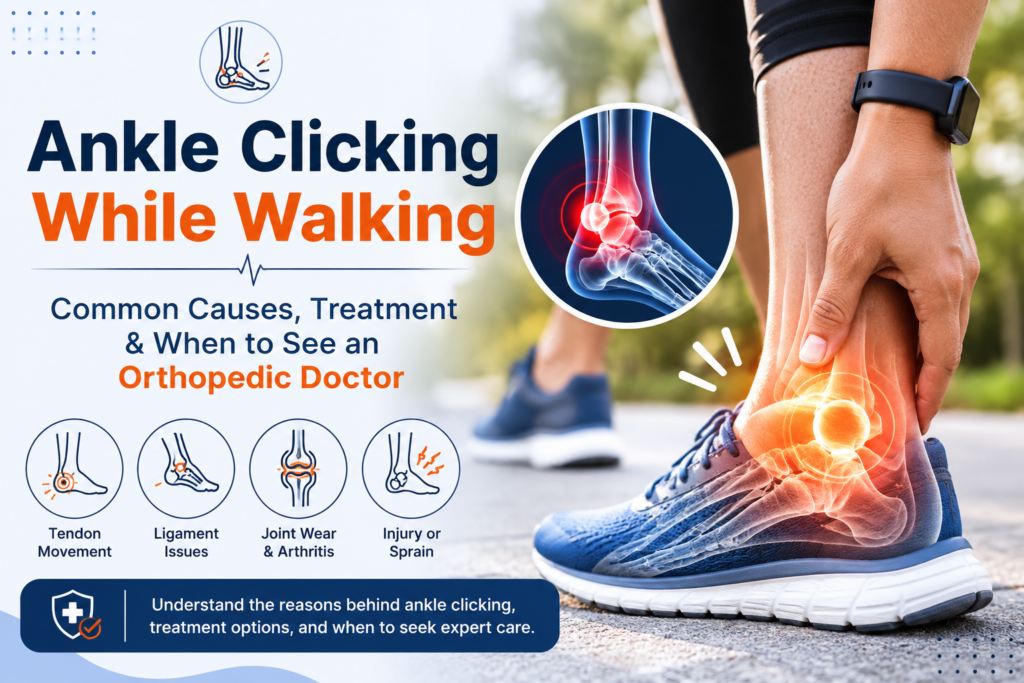
Have you ever noticed a clicking or popping sound coming from your ankle while walking? In many cases, ankle clicking is harmless and occurs when tendons move over the bones or when tiny gas bubbles inside the joint burst. However, if the clicking is accompanied by pain, swelling, instability, or repeated ankle injuries, it may indicate an underlying orthopedic condition that should be evaluated.
Is Ankle Clicking Normal?
Many people experience occasional clicking in their ankles without any pain or discomfort. This is often considered a normal joint phenomenon and does not require treatment.
However, persistent clicking associated with pain, stiffness, swelling, or difficulty walking should never be ignored.
Common Causes of Ankle Clicking
Tendons Moving Over Bone
One of the most common reasons for ankle clicking is the movement of tendons around the ankle joint. As the foot moves, a tendon may briefly shift over a bony prominence, producing a clicking sensation.
This is usually harmless unless it becomes painful.
Previous Ankle Sprain
After an ankle sprain, the supporting ligaments may become stretched or weakened.
This can lead to:
- Recurrent clicking
- Ankle instability
- Repeated twisting injuries
- Discomfort while walking
Many patients continue to experience these symptoms months after what seemed like a “minor” sprain.
Ligament Laxity
Loose ligaments allow excessive movement inside the ankle joint.
This increased mobility may result in:
- Popping sounds
- Instability
- Occasional giving way of the ankle
- Discomfort during sports or climbing stairs
Cartilage Damage
The smooth cartilage inside the ankle helps bones glide without friction.
When cartilage becomes damaged due to injury or arthritis, patients may notice:
- Grinding
- Clicking
- Stiffness
- Pain during movement
Early Osteoarthritis
As joint cartilage gradually wears down, ankle movement may become rougher.
Symptoms often include:
- morning stiffness
- swelling
- pain after walking
- clicking or grinding noises
When Should You Be Concerned?
Seek an orthopedic evaluation if ankle clicking is associated with:
- persistent pain
- swelling
- redness
- inability to bear weight
- repeated ankle sprains
- a feeling that the ankle may “give way”
- locking of the joint
- reduced range of motion
These symptoms may indicate ligament injuries, cartilage damage, tendon disorders, or arthritis.
How Is the Cause Diagnosed?
An orthopedic specialist will begin with a detailed medical history and physical examination.
Depending on your symptoms, additional investigations may include:
- X-rays to evaluate bone alignment and arthritis
- MRI to assess ligaments, tendons, and cartilage
- Ultrasound for certain tendon conditions
- CT scan in selected cases involving complex injuries
The appropriate test depends on the suspected cause rather than ordering every investigation.
Treatment Options
Treatment depends entirely on the underlying diagnosis.
Conservative Management
Many patients improve with non-surgical treatment such as:
- activity modification
- physiotherapy
- ankle-strengthening exercises
- balance training
- supportive footwear
- ankle braces when indicated
- anti-inflammatory medications prescribed by a doctor
Surgical Treatment
Surgery is considered only when conservative measures fail or when significant structural damage is present.
Procedures may include:
- ligament reconstruction
- tendon repair
- ankle arthroscopy
- cartilage restoration procedures
The choice of surgery depends on the specific problem identified during evaluation.
Can Ankle Clicking Be Prevented?
While not every cause can be prevented, you can reduce your risk by:
- strengthening the muscles around the ankle
- warming up before exercise
- wearing appropriate footwear
- treating ankle sprains properly
- avoiding repetitive overuse
- maintaining a healthy body weight
Frequently Asked Questions
Should I worry if my ankle clicks but doesn’t hurt?
Occasional painless clicking is usually harmless. However, if it becomes frequent or is associated with instability, swelling, or pain, it is advisable to seek an orthopedic evaluation.
Can ankle clicking indicate arthritis?
Yes. Persistent clicking accompanied by stiffness, swelling, and pain may be associated with degenerative joint changes such as osteoarthritis.
Can physiotherapy help?
Yes. Physiotherapy can improve muscle strength, balance, and joint stability, particularly when symptoms are related to ligament weakness or previous ankle injuries.
Is surgery always necessary?
No. Most patients with ankle clicking do not require surgery. Treatment depends on the underlying cause and the severity of symptoms.
When Should You Consult an Orthopedic Surgeon?
If ankle clicking is persistent, painful, associated with swelling, repeated sprains, or affects your daily activities, a timely orthopedic evaluation can help identify the underlying cause and guide appropriate treatment. Early diagnosis may prevent further joint damage and support a quicker return to normal activity.